Your monitoring found the outage in 60 seconds. So why is your MTTR still measured in hours?
“Our engineers are the integration between the monitoring system and the carrier.”
Nobody writes that in a job description, but it’s the reality in most NOCs. The monitoring platform does its part fast. The carrier does its part once it knows there’s a problem. And in between sits a person with a browser tab, a spreadsheet, and a phone on speaker playing hold music.
If you’re trying to reduce network MTTR, that person’s workload is where most of your time is hiding.
Where your MTTR actually goes
Break down a typical WAN circuit outage and the timeline looks something like this:
- Detection (about 60 seconds). Monitoring flags the circuit as down. This part is already solved.
- Validation. An engineer confirms it’s a real outage and not a flapping interface or a local power issue.
- Lookup. Someone finds the circuit ID, account number, and service address, usually in a spreadsheet that may or may not be current.
- Contact. They open the carrier portal or dial the support line and work through the phone tree.
- Hold and explain. They wait, then walk a rep through the problem from scratch.
- Ticket opened. Only now does the carrier start looking.
Steps two through six typically cost 20 to 40 minutes of an engineer’s time on every single outage. None of that is repair time. It’s transcription and waiting. And because it happens before the carrier’s clock even starts, it lands directly on your MTTR.
The overnight problem
During business hours, that 20 to 40 minutes is a productivity drain. After hours, it gets worse. An outage at 2 a.m. means one of two things: you pay for an on-call engineer to wake up and make the call, or the ticket doesn’t get opened until someone logs in the next morning.
Either way, the branch, clinic, school, or store is down longer than it needs to be, and the delay has nothing to do with how fast the carrier can fix it.
Why “just use the carrier’s API” isn’t enough
Some carriers offer ticketing APIs, and where they exist, they’re the fastest path. The problem is coverage. Most multi-location organizations work with a mix of carriers, and plenty of them still expect you to call. APIs also fail: credentials expire, endpoints change, requests time out.
An automation strategy that only works when the API cooperates still leaves you with outages where nobody opened a ticket. That’s the scenario that hurts most, because everyone assumes the system handled it.
How SmartTile 2.0 closes the gap
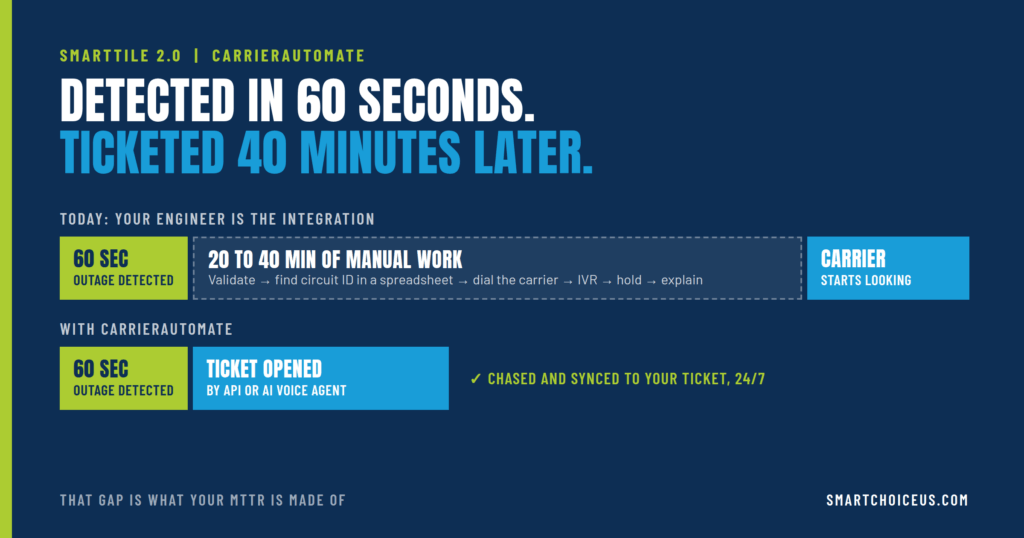
SmartTile 2.0 includes CarrierAutomate, which takes the engineer out of the middle of the process entirely:
- Detects the outage through continuous monitoring
- Validates it before acting, so you’re not opening tickets on false alarms
- Opens the carrier ticket itself, by API where the carrier has one, and by an AI voice agent where it doesn’t. The voice agent navigates the carrier’s IVR and talks to the rep, the same way your engineer would.
- Chases the ticket on its own schedule instead of waiting for the carrier to send an update
- Writes every update back into your own ticket, so your team sees status without logging into a carrier portal
The result is that the carrier starts working the problem in the same window your monitoring detects it, day or night.
API-first, with a voice agent as the safety net
CarrierAutomate is built API-first for each carrier, with the voice agent as the fallback. If an API call fails, the voice agent picks it up, so a broken integration never turns into a ticket nobody opened.
Today, Verizon and Granite run over their APIs, and credential slots are already configured for eight additional carriers.
Questions to ask about your own MTTR
If you want a quick read on how much of your MTTR is carrier overhead, start here:
- How long does it take from alert to open carrier ticket, on average?
- Who opens tickets overnight and on weekends, and what does that cost you in callouts?
- Where do circuit IDs and account numbers live, and how often is that source out of date?
- How does your team get carrier status updates today: proactive, or by calling back?
- If a carrier API fails, what catches it?
If the honest answers involve a spreadsheet, a phone, and “whoever is on call,” your monitoring isn’t the bottleneck. The handoff is.
Stop making your engineers the integration
Your monitoring knows about the outage in 60 seconds. The gap between that alert and an open carrier ticket is what your MTTR is actually made of. SmartTile 2.0 closes it automatically, so your engineers can spend their time on the problems that actually need them.
See how SmartTile handles carrier tickets → Agentic AI Automation & Network Management | SmartChoice