Your Monitoring Tool Told You It’s Down. Now What?
“It tells me something’s down. Then I still have to call the carrier.”
If you run IT for a multi-location business, you’ve said some version of this sentence more times than you’d like. SolarWinds, PRTG, Auvik, whatever sits on your NOC screen right now, it’s very good at one job: watching devices and throwing an alert when something stops responding. What none of these tools do is pick up the phone.
Monitoring Stops at the Alert. The Outage Doesn’t.
Here’s the gap almost every IT team lives with. A WAN circuit at a branch office drops. Your monitoring platform flags it within seconds, sometimes even sends a text or a Slack ping. Great. Then the real work starts, and none of it is in the tool:
- Someone has to identify which carrier owns that circuit
- Someone has to find the account number, the circuit ID, the service address
- Someone has to call AT&T, Lumen, Zayo, Spectrum, or whoever it is that day
- Someone waits on hold, explains the issue to a rep who’s never seen your network, and opens a ticket
- Someone then checks back periodically because the carrier isn’t proactively updating you
Multiply that by however many locations and however many carriers you juggle, and monitoring software has become an expensive way to find out you have more manual work to do.
The Real Cost Isn’t the Outage. It’s the Gap After the Alert.
Mean time to resolution (MTTR) doesn’t start when the carrier fixes the circuit. It starts the moment the circuit drops, and every minute your team spends tracking down account numbers or holding for a rep counts against it.
For a single-location business, that’s an annoyance. For an organization running dozens or hundreds of sites, private equity portfolio companies, multi-location healthcare groups, school districts, retail chains, it’s a structural drain on the IT team. The people who should be solving problems are instead playing carrier switchboard operator, and every hold-music minute is time your locations sit dark.
What Carrier Ticket Automation Actually Looks Like
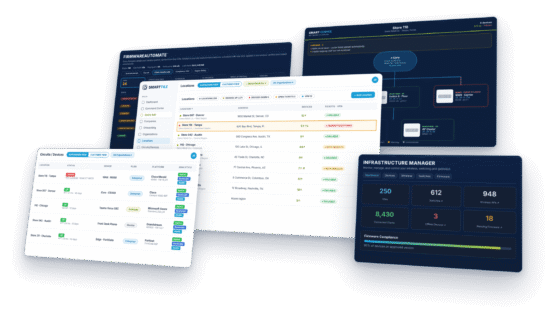
This is the specific gap SmartTile was built to close. Instead of stopping at “here’s an alert,” SmartTile treats the carrier as part of the monitoring workflow, not a separate manual process bolted on after it.
Real-time detection, not periodic checks. SmartTile polls devices every 30 seconds, so a circuit drop is caught fast, before it quietly costs you an hour of undetected downtime.
Automated carrier ticket creation. When SmartTile detects a WAN circuit down, it can automatically generate and submit a carrier ticket, no one has to look up an account number or dial a support line first.
Location-based escalation. Because SmartTile ties circuits to specific sites, tickets route with the right account and location context attached from the start, cutting down the back-and-forth that usually eats the first 20 minutes of any carrier call.
One system of record. Instead of monitoring in one tool and tracking carrier tickets in email threads or spreadsheets, your team sees device status and carrier ticket status in the same place.
What to Look For if You’re Evaluating a Replacement
If this pain point sounds familiar, here’s a short checklist for whatever you evaluate next, whether that’s SmartTile or another platform:
- Does it monitor devices, or does it monitor circuits too? Device-level monitoring alone won’t tell you which carrier to call.
- Can it open a carrier ticket automatically, or just alert a human to do it? This is the actual line between “monitoring” and “monitoring with carrier integration.”
- Does it know which carrier owns which circuit at which location? Without that mapping, automation has nothing to act on.
- Can your team see ticket status without leaving the platform? If resolving an outage still means tabbing over to a carrier portal or an inbox, you’ve only automated half the problem.
The Bottom Line
An alert that tells you something’s down is table stakes. The tools worth paying for in 2026 close the loop after the alert, so your team isn’t the one dialing the carrier, holding, and re-explaining the problem every time a circuit blinks out.
That’s the difference between network monitoring and carrier ticket automation. If your current stack only does the first half, see how SmartTile handles the second half.