You watch the network like hawks. Who’s watching the cloud?
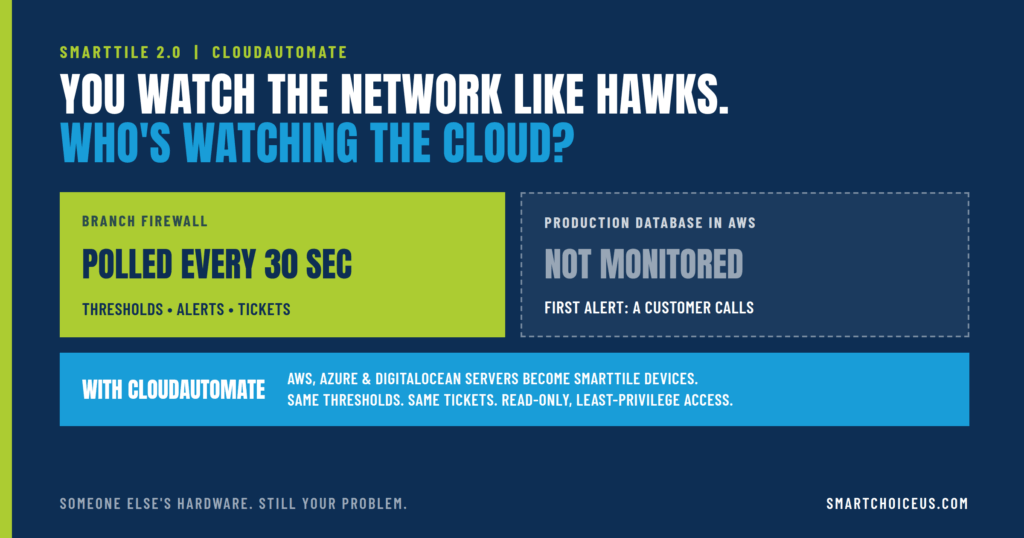
This happens in a lot of IT shops. The branch firewall gets polled every 30 seconds. Every switch and access point has thresholds, alerts and an escalation path. Then there’s the production database running in AWS, the app servers in Azure, and the DigitalOcean droplet someone set up two years ago. None of them are monitored at all.
So the first sign of trouble is a customer calling to say something’s broken.
How the cloud fell outside the NOC
Nobody decided to leave cloud servers unmonitored. It usually happens in steps:
- Different owners. Network gear belongs to the infrastructure team. Cloud workloads often got spun up by developers, a project team, or an outside vendor.
- Different tools. Each cloud provider has its own console and its own native alerting, and none of it shows up where the NOC actually looks.
- “Someone else’s hardware” thinking. When AWS or Azure owns the physical server, it’s easy to assume uptime is their problem. It isn’t. The provider keeps the platform running. Whether your instance, database or service is healthy is still on you.
- Permission anxiety. Giving a monitoring tool access to a cloud account feels risky, so the conversation stalls and nothing gets connected.
What you end up with is a NOC that has deep visibility into the parts of the business that rarely fail, and none into the parts customers actually touch.
What that blind spot costs
When a branch circuit drops, you know within seconds. When a production server in the cloud goes down, you find out from:
- A customer who can’t log in or check out
- An employee who can’t reach an internal app
- A developer who happens to notice something looks off
By then the outage has been running for however long it took someone to notice and call. Your response time starts at the complaint, not at the failure. That hurts customer trust, and it hurts your team’s credibility, because the question afterward is always “why didn’t monitoring catch this?”
How SmartTile 2.0 brings the cloud into the NOC
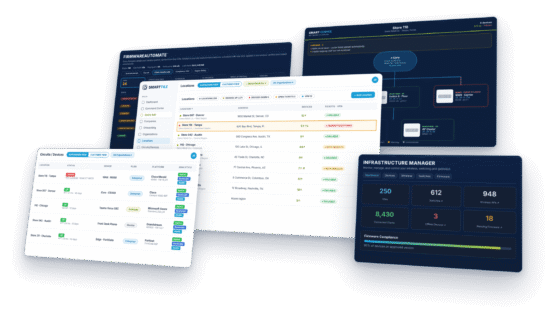
SmartTile 2.0 includes CloudAutomate, which puts cloud servers on the same footing as everything else you monitor.
- AWS, Azure and DigitalOcean servers are imported as ordinary SmartTile devices. No separate dashboard, no second tool to learn.
- Each one lands under a location named for its region, so cloud resources sit in your inventory next to your physical sites.
- Same buttons, same thresholds, same tickets as a firewall. An unhealthy cloud server alerts and escalates exactly the way a down branch device does.
To your NOC, the production database in us-east-1 is just another location to watch.
Read-only access, scoped by you
The permission question is usually what stalls cloud monitoring projects, so CloudAutomate starts there.
You choose exactly which permissions to grant. SmartTile then generates the least-privilege IAM policy (for AWS) or Azure role that covers only those permissions and nothing else.
And the access is read-only by design. Nothing SmartTile asks for can create, change or delete a resource. Your security team can review the policy before it goes live, and they’ll see that monitoring can look but never touch.
Questions to ask about your own coverage
For a quick check on whether you have a cloud blind spot:
- Which production workloads run in AWS, Azure or DigitalOcean today, and who owns each one?
- If one of those servers went down at 2 a.m., what would alert you?
- Do cloud alerts reach the same people and ticketing system as your network alerts?
- Are your cloud resources in the same inventory as your physical infrastructure?
- What’s holding up giving your monitoring platform read-only cloud access?
If the honest answer to the second question is “a customer,” the gap is real.
The cloud is still your problem
Most teams poll the branch firewall every 30 seconds and don’t monitor the production database in AWS at all. Cloud servers are still your responsibility, even though they run on someone else’s hardware. SmartTile 2.0 brings them into the same view, the same thresholds and the same ticketing workflow as the rest of your network, with read-only access you control.
See how SmartTile monitors your cloud servers → Network monitoring software | SmartTile