10 AI-driven network management tasks
Modern networks are larger, more distributed, and more business-critical than ever. Cloud applications, remote users, connected devices, branch locations, security tools, and hybrid infrastructure all create more traffic, more alerts, and more operational complexity. Traditional network management methods still matter, but manual monitoring and reactive troubleshooting are no longer enough for teams that need speed, reliability, and scale.
That is where AI-driven network management becomes valuable. By combining data collection, machine learning, automation, analytics, and policy-based workflows, IT teams can move from “finding and fixing” problems to predicting, preventing, and automatically resolving them. The result is a smarter operating model: fewer repetitive tasks, faster decisions, better visibility, and more consistent service delivery.
AI does not replace network professionals. Instead, it gives them better tools. The most effective approach pairs human expertise with network automation technology that can detect patterns, prioritize issues, recommend actions, and execute approved workflows across complex environments.

Why AI-driven network management matters
Network teams are under pressure to deliver always-on connectivity while managing more endpoints, more vendors, more data, and more security risks. The challenge is not just volume; it is speed. A slow application, misconfigured device, bandwidth spike, or intermittent outage can affect customer experience and employee productivity before a human operator has time to investigate.
AI network management helps by continuously analyzing operational data from across the environment, including performance metrics, device health, logs, topology, traffic patterns, and user experience signals. Instead of waiting for an administrator to manually connect the dots, intelligent systems can surface what matters most.
Common benefits include:
- Faster root cause analysis
- Reduced alert fatigue
- More proactive maintenance
- Better capacity planning
- Improved security visibility
- More consistent configuration management
- Lower operational overhead
- Stronger support for hybrid and distributed environments
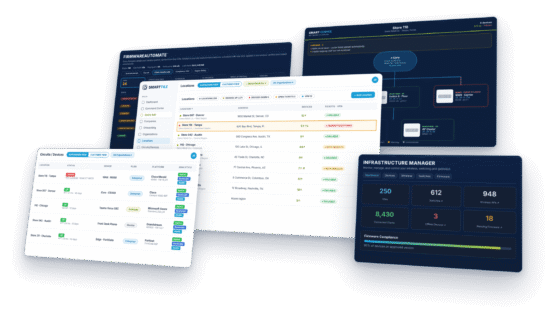
Platforms such as SmartTile bring these ideas together through AI and automation-driven features that help teams monitor networks, identify issues, streamline workflows, and make more informed operational decisions from a centralized management experience.
1. Intelligent network monitoring
Monitoring is one of the most important use cases for AI-driven network management. Traditional monitoring tools often focus on thresholds: if CPU usage, latency, packet loss, or bandwidth crosses a predefined limit, an alert is triggered. While useful, static thresholds can generate too many false positives or miss subtle patterns.
AI-enhanced monitoring adds context. It can learn normal behavior for different devices, sites, applications, and time periods. For example, a bandwidth spike during a scheduled backup may be normal, while a similar spike at another time could indicate a problem. By understanding baseline behavior, AI can help teams identify meaningful anomalies rather than simply reporting every metric change.
This makes monitoring more actionable. Instead of asking teams to manually review hundreds of alerts, intelligent systems can highlight unusual events, group related symptoms, and help operators focus on the issues most likely to affect service quality.
2. Anomaly detection and early warning
Some network problems develop gradually. A circuit may become unstable, a device may begin dropping packets, or an application path may degrade over several hours. If these changes remain below static alert thresholds, teams may not notice them until users complain.
AI-driven anomaly detection is designed to catch these early signals. By analyzing historical and real-time data, it can identify unusual behavior that may indicate a developing issue. This is especially useful for intermittent problems, which are often difficult to diagnose because they appear and disappear before an engineer can manually investigate.
Early warning capabilities help teams move from reactive support to proactive operations. Instead of responding after an outage, administrators can investigate warning signs, validate risk, and take corrective action before a minor issue becomes a major incident.
3. Automated root cause analysis
Root cause analysis is often one of the most time-consuming parts of network troubleshooting. A single user-facing issue may involve switches, routers, wireless access points, firewalls, DNS, cloud services, WAN links, and application infrastructure. Without automation, engineers may need to manually check each layer.
Intelligent network solutions can speed up this process by correlating events across the environment. If multiple alerts occur at the same time, AI can help determine whether they are separate problems or symptoms of one underlying cause. For example, if several branch users report application slowness, the system may correlate the issue with WAN latency, interface errors, or a recent configuration change.
Automated root cause analysis does not eliminate the need for expert review, but it shortens the path to understanding. Engineers can begin with a ranked list of likely causes instead of starting from scratch.
4. Predictive maintenance
Predictive maintenance uses data patterns to anticipate failures before they happen. In a network environment, this may involve identifying hardware degradation, recurring interface errors, increasing memory usage, unstable wireless performance, or devices approaching resource limits.
This task is a strong fit for AI because network health data accumulates constantly. Over time, machine learning models can identify signals that commonly appear before failures or performance degradation. The system may recommend replacing hardware, updating firmware, adjusting capacity, or investigating recurring faults.
For IT leaders, predictive maintenance can support better planning. Instead of relying only on fixed refresh cycles or emergency replacements, teams can prioritize work based on operational risk and real-world device behavior.
5. Configuration management and compliance
Network configuration errors are a common source of outages and security exposure. A small mistake in routing, access control, VLAN assignment, firewall policy, or device template can create widespread issues.
AI and automation can improve configuration management by detecting drift, identifying risky changes, and comparing current configurations against approved standards. When paired with policy-based workflows, network automation technology can help ensure that changes are consistent across devices and locations.
Useful configuration tasks include:
- Detecting unauthorized or unexpected configuration changes
- Comparing device settings to approved baselines
- Flagging misconfigurations that may affect performance or security
- Recommending standardized templates
- Automating approved remediation steps
- Documenting changes for audit and operational review
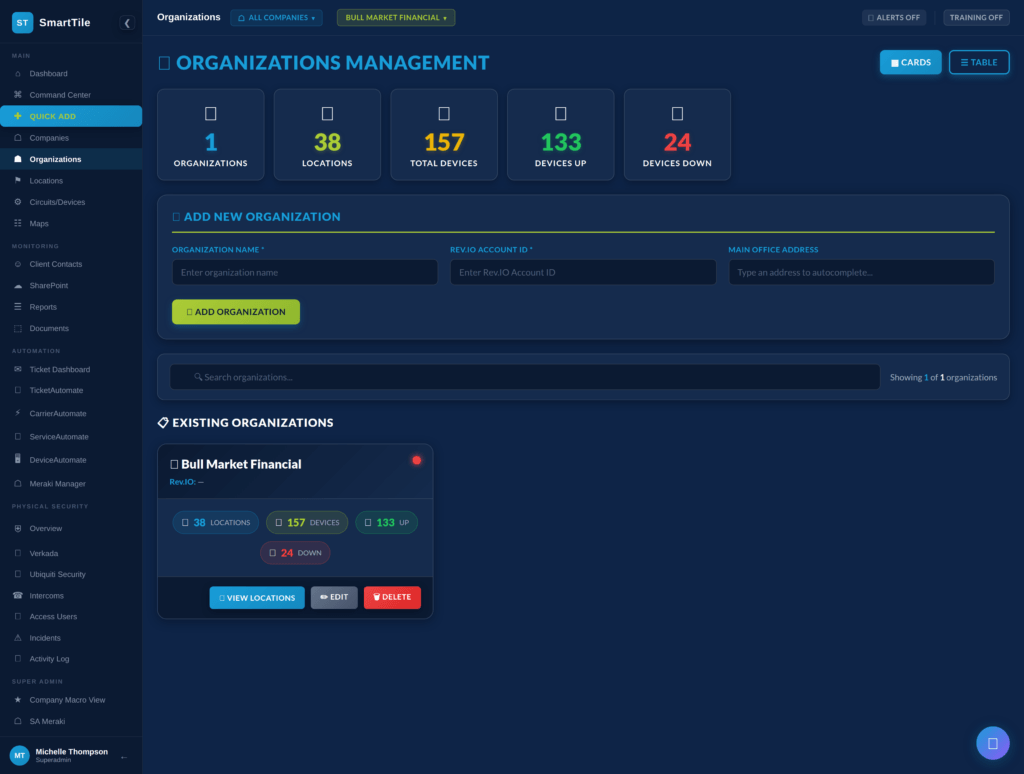
A platform like SmartTile can support this type of work by combining visibility, automation, and AI-assisted insights so teams can manage network changes with greater confidence.
6. Performance optimization
Networks are dynamic. Traffic patterns change as users adopt new applications, business locations grow, cloud services shift, and devices move across wired and wireless environments. Performance optimization requires continuous attention, but manually tuning every part of the network is rarely practical.
AI network management can analyze performance data and recommend optimization actions. This may include adjusting routing paths, balancing traffic, identifying congested links, prioritizing critical applications, or tuning wireless coverage. In some environments, automation can apply approved changes directly, while in others it may generate recommendations for engineering review.
The value comes from continuous learning. Rather than optimizing based only on a snapshot in time, AI can evaluate patterns across days, weeks, and usage cycles. This helps teams make decisions based on actual network behavior instead of assumptions.
7. Alert correlation and noise reduction
Alert fatigue is a major challenge in network operations. When every device, interface, and application produces notifications, teams can become overwhelmed. Important alerts may be missed simply because they are buried in noise.
AI-driven alert correlation helps solve this problem by grouping related alerts, suppressing duplicates, and prioritizing events based on probable business impact. Instead of showing 50 separate alerts from affected devices, the system may present one incident with supporting evidence.
This improves response quality. Operators can focus on incidents rather than individual symptoms. It also helps managers understand operational risk more clearly, because alerts are organized around service impact rather than raw technical volume.
Strong alert management should include:
- Event grouping
- Severity scoring
- Business impact context
- Historical comparison
- Suggested next actions
- Integration with ticketing or workflow tools
When these capabilities are combined with automation, teams can respond faster and more consistently.
8. Security threat detection support
Network management and security operations are closely connected. While dedicated security tools remain essential, AI-driven network management can add important visibility by analyzing traffic behavior, access patterns, device activity, and unusual communications.
For example, AI may help identify abnormal traffic between systems, unexpected device behavior, unusual login patterns, or bandwidth usage that does not match historical baselines. These insights can support security investigations and help teams detect potential compromise, misconfiguration, or policy violations.
The goal is not to turn a network management platform into a full security operations center. Rather, it is to use network intelligence as another layer of awareness. When network and security teams share better context, they can investigate incidents more efficiently and reduce blind spots.
9. Capacity planning and forecasting
Capacity planning is often difficult because network demand changes over time. New applications, business growth, video usage, IoT deployments, cloud migrations, and remote work patterns can all affect bandwidth and infrastructure requirements.
AI can improve forecasting by analyzing historical utilization, growth trends, seasonal patterns, and peak usage windows. Instead of reacting after a link becomes saturated or a device reaches capacity, teams can plan upgrades based on projected demand.
This is especially useful for distributed organizations with many sites. AI-assisted forecasting can help prioritize which locations need attention first, which links are underutilized, and where future investment is likely to deliver the greatest operational benefit.
Capacity planning can support decisions such as:
- When to upgrade WAN circuits
- Where to add wireless access points
- Which devices may need replacement
- How to support new applications
- How to prepare for business expansion
- Whether current infrastructure is aligned with future demand
Better forecasting helps organizations spend more strategically and reduce the risk of performance surprises.
10. Automated remediation workflows
One of the most powerful uses of AI-driven network management is automated remediation. After a system detects an issue, it can trigger a predefined workflow to resolve or contain the problem. Depending on the environment and approval model, remediation may be fully automated or require human confirmation.
Examples include:
- Restarting a failed service
- Reapplying a known-good configuration
- Opening and enriching a support ticket
- Notifying the correct team
- Rolling back an approved change
- Isolating a problematic device
- Redirecting traffic to a healthier path
- Running diagnostic commands
- Collecting logs for investigation
Automation is most effective when it is governed by clear policies. Not every action should happen automatically, especially in sensitive production environments. A mature approach uses guardrails, approvals, role-based access, and audit trails so teams can gain speed without losing control.
SmartTile’s AI and automation-driven features are designed to support this kind of operational efficiency, helping teams move from manual response to more repeatable, guided, and intelligent network workflows.
Best practices for adopting AI network management
AI works best when it is implemented with the right strategy. Simply adding a new tool will not automatically improve network operations. Teams should begin with clear goals, reliable data, and well-defined workflows.
Start with high-value use cases. Many organizations begin with monitoring, alert correlation, anomaly detection, or automated ticket enrichment because these areas deliver practical benefits quickly. Once teams trust the insights, they can expand into more advanced automation and remediation.
Focus on data quality. AI-driven tools depend on accurate and complete information. Device inventories, topology maps, configuration records, performance metrics, and event logs should be maintained as cleanly as possible.
Keep humans in the loop. Automation should support expert decision-making, not bypass it without oversight. For critical actions, approval workflows and change controls are essential.
Measure outcomes. Track metrics such as mean time to detect, mean time to resolve, alert volume, incident frequency, network availability, and manual hours saved. These measurements help demonstrate the value of intelligent network solutions and guide continuous improvement.
The future of network operations is intelligent and automated
As networks continue to grow more complex, AI and automation will become central to how teams manage performance, reliability, security, and change. The most successful organizations will not use AI as a standalone feature; they will embed it into daily operations, from monitoring and troubleshooting to planning and remediation.
With platforms like SmartTile, organizations can take a more modern approach to network management by using AI-assisted insights and automation-driven workflows to improve visibility, reduce repetitive work, and respond faster to operational challenges.
The goal is simple: help network teams spend less time chasing noise and more time delivering secure, reliable, high-performing connectivity for the business.