Granite repair tickets opened by API, not by phone
The SmartTile Granite Telecom integration opens the repair ticket the moment a Granite circuit is confirmed down, then keeps Granite’s status and notes in step until it closes.
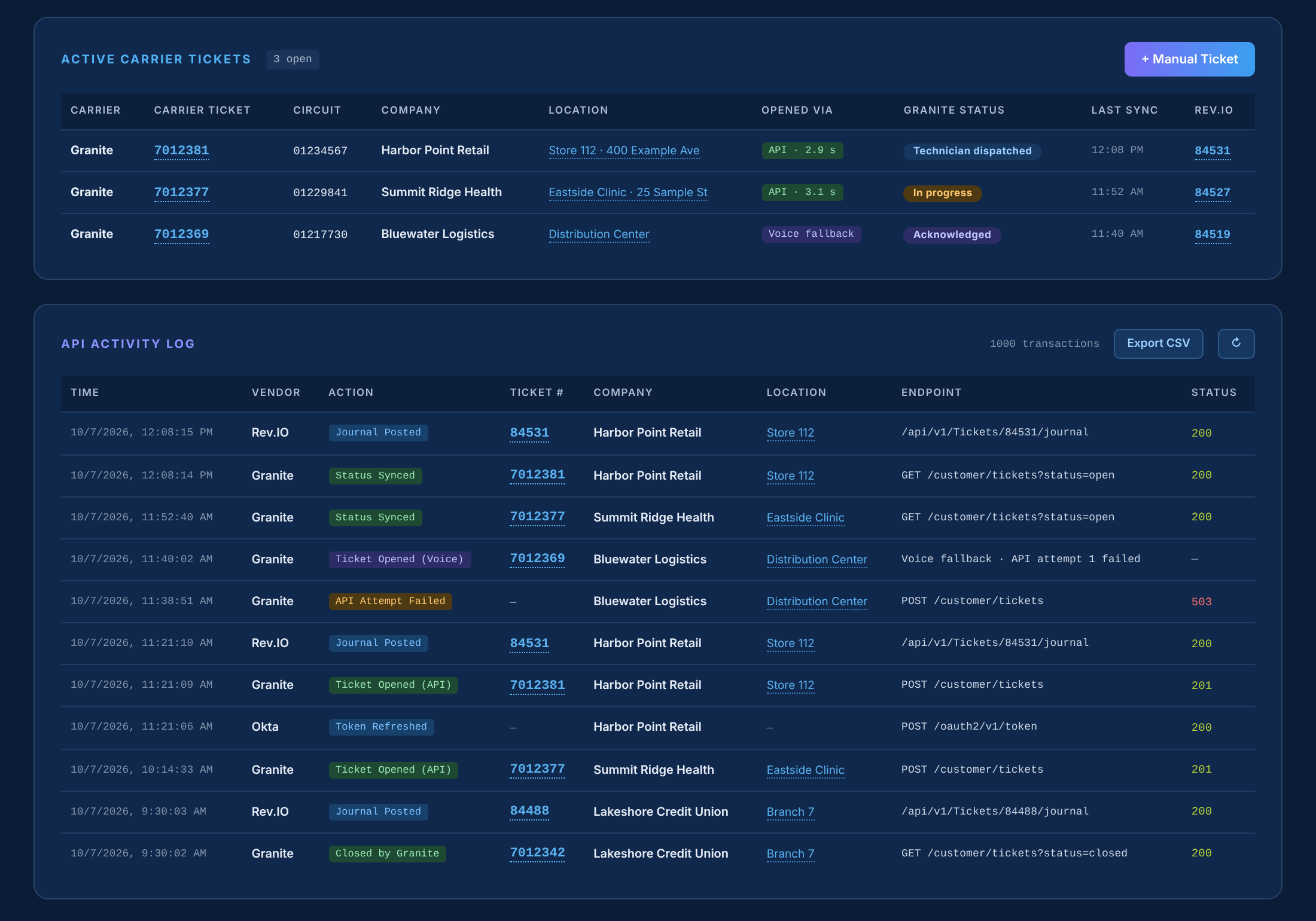
Carrier repair still runs on hold music.
When a Granite circuit drops, someone calls Granite, finds the child account, reads out the circuit and site contact, then calls back for updates. SmartTile opens the ticket through your own Granite API credentials, with no call placed.
What your team gets from the Granite Telecom integration
Repair tickets in seconds
On a confirmed outage, SmartTile opens the Granite repair ticket over the API. No phone call, no portal login.
Everything Granite needs, sent once
Summary, circuit, site address, outage time, the SmartChoice reference and the on-site contact.
The ticket number, logged for you
Granite’s ticket number is written to the SmartChoice ticket as an internal note, automatically.
Updates without calling back
Every 30 minutes SmartTile reads Granite’s status and notes, and posts them only when something changed.
A fallback that never drops the ball
If the API fails, SmartChoice’s voice agent calls Granite with the same details. Ten failed tries hands it to a live engineer.
Your credentials stay yours
Granite issues API credentials to you. They stay encrypted on your own SmartTile instance.
What changes for a Granite circuit
| The moment | Today | With SmartTile |
|---|---|---|
| A Granite circuit goes down | Someone calls Granite, finds the account, reads out the circuit. | The ticket opens by API with circuit, address, outage time and site contact. |
| The ticket number | Copied by hand into the internal ticket. | Written to the SmartChoice ticket automatically. |
| Keeping up with Granite | Call back, or log in to the portal. | Status and notes pulled every 30 minutes, posted only when changed. |
| The API has a bad day | No plan B. | The failure is logged and a voice call is placed instead. |
Why IT leaders add it to their stack
Carrier repair without adding staff
Tickets open and update themselves, so your team works the fix, not the phone.
Granite’s customer REST API
Okta OAuth2 client credentials, held on your own SmartTile instance.
Credentials never leave your instance
Your Granite client ID and secret stay encrypted on your SmartTile. The platform only sees the answer.
No hold music, no portal logins
Every Granite outage is ticketed, numbered and tracked automatically.
Live with your Granite credentials
-
1Get your Granite credentialsYour Granite account team issues an Okta client ID, secret, token URL and scope.
-
2Enter them in SmartTileOn your own SmartTile, under CarrierAutomate and Granite.
-
3Run the Data Sync TestConfirms ownership of the circuits, a valid token, and a ticket read-back.
-
4Go liveAPI-first is on by default.
API-first is on by default, and three switches stay in your control: API first, voice fallback and a kill switch.
Security and control
Learn exactly how it works
The two-page technical overview lists every Granite API call SmartTile makes, how your Granite credentials stay on your own instance, and what happens when the API has a bad day.
Granite Telecom integration FAQs
Does SmartTile close the Granite ticket?
No. Closing isn’t part of this integration. SmartTile records when Granite reports the ticket closed.
Does Granite push updates, or does SmartTile check?
SmartTile checks Granite every 30 minutes and posts updates when something changed.
What happens if the Granite API is down?
SmartChoice’s voice agent calls Granite with the same details, and the log says why the API wasn’t used.
Why does Granite repair ticket automation use our credentials?
Granite issues API credentials to the end customer, not to SmartChoice. They stay encrypted on your own SmartTile instance.
Which other carriers can SmartTile ticket with?
Verizon (beta), plus ticket clients for Lumen, Zayo and Spectrum, and portal automation for carriers without an API.
Works with the rest of your stack
The Granite ticket is open, numbered and logged before anyone would have finished dialing
See carrier ticket automation in a 30-minute demo.